How the 14 strings are grouped
The bandurria is the small, pear-shaped melody instrument of the Filipino rondalla. It has 14 metal strings in six courses. A course is a group of strings that you pluck together and that plays one note. The 6th course (the lowest) has one string. The 5th and 4th courses have two strings each. The 3rd, 2nd and 1st courses have three strings each: 1 + 2 + 2 + 3 + 3 + 3 = 14. This is the layout described by the UP Alumni and Friends Rondalla for the bandurria, the laud and the octavina.
All the strings in one course play the same note in the same octave (a unison). There are no octave strings, as on a 12-string guitar. So the job is simple to describe: tune every string to the note of its course, then check that the strings of each course sound like one.
The courses are numbered from the highest note. The 1st course is G, the thinnest strings. The 6th course is the single F♯ bass string. When you hold the bandurria to play, the 6th course is the one closest to your face.
Before you turn any peg, make sure you have a Filipino bandurria. The Spanish bandurria looks almost the same, but it has 12 strings in six pairs and is tuned a whole step higher: G♯3 C♯4 F♯4 B4 E5 A5. If your instrument has 14 strings in the 1-2-2-3-3-3 pattern, it is Filipino. Open the bandurria tuner in another tab and follow the steps below.
Bandurria notes and frequencies
From the lowest course to the highest, the Filipino bandurria is tuned F♯3 B3 E4 A4 D5 G5. Each course is a perfect fourth above the one below it. The UP Alumni and Friends Rondalla places the 1st course on “a high G”, the second G above middle C on the piano. That is G5. The Atlas of Plucked Instruments gives the same octaves. Many players learned the names in Do Re Mi, so the table shows both.
| Course | Strings | Note | Do Re Mi | Frequency |
|---|---|---|---|---|
| 1st | 3 | G5 | Sol | 783.99 Hz |
| 2nd | 3 | D5 | Re | 587.33 Hz |
| 3rd | 3 | A4 | La | 440.00 Hz |
| 4th | 2 | E4 | Mi | 329.63 Hz |
| 5th | 2 | B3 | Ti | 246.94 Hz |
| 6th | 1 | F♯3 | Fa♯ | 185.00 Hz |
The number after each letter is the octave. It matters. The bass string should read F♯3 at about 185 Hz, not F♯4 at 370 Hz. The 3rd course is the A at 440 Hz, the same A that orchestras use as a reference. That makes it a good course to check first.
The strings are not all the same type. On the set listed on the UP Alumni and Friends Rondalla bandurria page, the G and D courses are plain steel, and the A, E, B and F♯ courses are copper-wound steel. The wound strings are thicker and need more turns of the peg to change pitch.
Set up the tuner before you pluck
Find a quiet place. Fans, televisions and other players make the reading jump. Hold your phone or laptop about 20–30 cm from the sound hole.
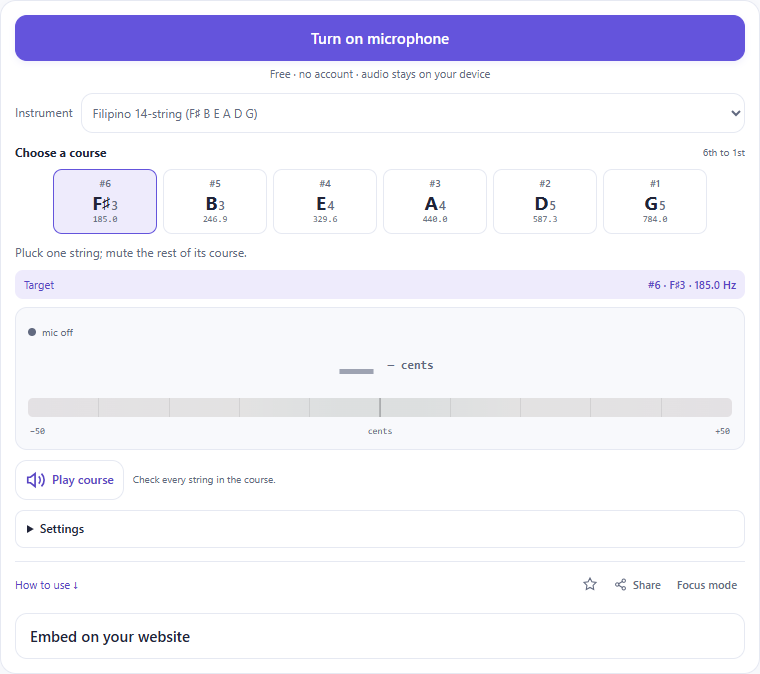
- Open the Lalatone bandurria tuner and tap Turn on microphone. Allow the microphone when the browser asks.
- In the first menu, keep Filipino 14-string (F♯ B E A D G). The page opens on this setting. The other options are the Spanish 12-string bandurria and the Spanish laúd.
- Look at the six course buttons, from #6 (F♯3, 185.0 Hz) to #1 (G5, 784.0 Hz). Tap a button to lock the tuner on that course. Then tap Play course to hear the target note.
- If you prefer the tuner to find the course by itself, open Settings and use Auto. Locking one course is easier for beginners, because the screen always compares your string with the same target.
- In Settings, check that Reference A is 440 Hz, unless your rondalla agrees on another value. You can also switch Note names to Do Re Mi.
Step by step: tune each course
Start with the 6th course and move up to the 1st. Tune one string at a time, never a whole course at once. If you pluck three strings together, the tuner hears a mix and the needle moves around.
- Select #6. Pluck the single F♯ string with your pick, with normal force. Let it ring.
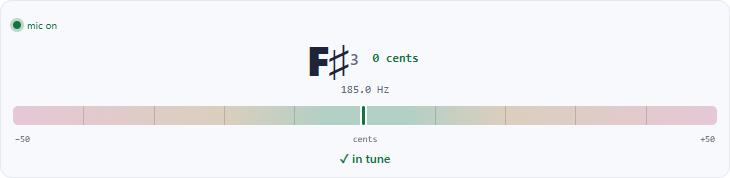
- Read the screen after the first attack fades. The note name, the frequency in Hz and the needle should be steady.
- If the screen says flat: tighten, turn the peg to raise the pitch. If it says sharp: loosen, lower it. Turn slowly: a small turn makes a big change on these short strings.
- Stop when the needle is centered and you see in tune. It is good practice to finish by coming up to the note from slightly below. The string then holds its pitch better.
- Select #5. Rest a fingertip lightly on one B string to mute it. Tune the other one. Then swap and tune the second string.
- Do the same for #4. For the three-string courses (#3, #2 and #1), mute two strings and tune the third. Repeat until all three read in tune.
- When you reach #1, go back to #6 and check everything again. Tightening 14 strings pulls on the neck and top, so the first courses often move a little.
Listen to each course together
After each string reads in tune, pluck the whole course. A good course sounds like one strong note. If you hear a slow “wah-wah” wobble, two strings are close but not equal. The slower the wobble, the closer they are. Mute one string at a time to find the one that is off, and make a very small correction until the wobble stops.
Check by ear with the 5th fret
Because every course is a fourth above the one below, the bandurria has an easy ear test: the 5th fret of one course gives the open note of the next higher course.
- 6th course, 5th fret = B3 = open 5th course
- 5th course, 5th fret = E4 = open 4th course
- 4th course, 5th fret = A4 = open 3rd course
- 3rd course, 5th fret = D5 = open 2nd course
- 2nd course, 5th fret = G5 = open 1st course
Play the fretted note and the open string one after the other, then together. If they wobble, adjust the open string. This test only tells you that the courses agree with each other. To play with a group, at least one course must match a shared reference. Tune the A course to 440 Hz first, with the tuner, a piano or a pitch pipe. Then work outward with the 5th-fret test.
You can also compare with the bigger instruments of the rondalla. The octavina and the laud use the same note names one octave lower. Their open courses sound an octave below your open courses, and their 12th fret gives the same pitch as your open string.
Common problems and how to fix them
New strings keep going flat
New strings stretch for the first days. Tune them, then hold each string near the middle and pull it gently away from the fretboard a few times. Tune again. Repeat two or three times. Expect to retune before every practice in the first week.
A string breaks while you tune up
The most common reason is the wrong octave. A tuner that shows only the letter cannot tell E4 from E5, so a player keeps tightening. String tension grows with the square of the pitch: one octave higher needs four times the tension, and a thin steel string will snap long before that. Read the octave number on the screen. If the note is right but the Hz is about double the value in the table, loosen the string a lot. The Spanish tuning also carries risk on a Filipino set: a whole step higher means about a quarter more tension on every string.
You turn a peg and nothing changes
With 14 pegs, it is easy to turn the neighbor. Follow the string from the nut to its peg with your finger. Turn very slightly while the string rings. If the reading does not move, it is the wrong peg: turn it back.
Your new string set has only 12 strings
Many sets sold as “bandurria strings” are made for the Spanish instrument. For example, the La Bella bandurria set sold by Lark in the Morning has twelve strings in six pairs and lists both the Spanish and the Philippine tunings. A 14-string bandurria needs three strings on each of the top three courses and only one on the bass. Count before you restring, or buy extra single strings.
Your group tunes to another A
All instruments in the rondalla must use the same reference. If the director asks for A = 442 Hz, change Reference A in Settings before you start. The note names stay the same; every target moves together.
Quick answers
What are the bandurria notes in Do Re Mi?
From the 6th course to the 1st: Fa♯, Ti, Mi, La, Re, Sol. In letters: F♯ B E A D G.
How do I tune a 12-string bandurria?
A 12-string bandurria in six pairs is usually the Spanish model, tuned G♯3 C♯4 F♯4 B4 E5 A5. Choose Spanish 12-string in the first menu. If your teacher says your 12-string instrument uses the Filipino notes, keep the Filipino setting and tune both strings of each pair to the same note.
Can I use a guitar tuner?
Only in chromatic mode, and only if you know the target notes and octaves from the table. A normal guitar preset expects E A D G B E, which is a different instrument. The bandurria tuner already has the six courses ready, with the correct octaves.