The seven strings of a Saraswati veena
A Saraswati veena has four main strings that you play on the frets, and three side strings, called tala strings, that run along the edge of the neck. The main strings carry the melody. The tala strings give a drone and mark the rhythm. All seven are tuned only to Sa and Pa, in different octaves.
Teachers number the main strings from the first, the thinnest and highest, to the fourth, the thickest and lowest. Mala Viswanathan, a veena teacher, names them in her guide Tuning the Saraswathi Veena:
- 1st string, Sarani: Sa, the reference for everything else.
- 2nd string, Panchama: Pa, below the Sa of the first string.
- 3rd string, Mandra: Sa, one octave below the first string.
- 4th string, Anumandra: Pa, one octave below the second string.
So the pattern from the first to the fourth string is Sa, lower Pa, lower Sa, lowest Pa. Other teachers use other names for the same strings, but the Sa–Pa pattern is the same in the sources we checked. The Saraswati veena tuner uses these four strings. Its buttons are labelled "1 · Sa", "2 · Pa", "3 · Sa low" and "4 · Pa low", so you always know which physical string you are tuning.
First choose your Sa
Sa is not a fixed note like A or C. Each musician chooses a pitch for Sa, and the whole veena follows it. Mala Viswanathan writes that the first string can be tuned to D, D♯, E or F. In her experience, D and D♯ leave the strings loose enough for gamakas, E sits in the middle, and F makes the strings tight and suits only some kinds of music. She prefers E. An acoustics study of the instrument by Chauhan, Singru and Vathsan tuned the first main string to 175 Hz, which is very close to F3.
Your teacher, your singer or your shruti box decides the final choice. If you play with a vocalist, use the Sa of the performance. If you practise alone, keep the Sa your teacher gave you, so that your hand and ear learn one feeling of string tension.
The table shows the four main strings with Sa = D3, the default preset of the tuner. Notes use scientific octave numbers (middle C is C4) and frequencies use A4 = 440 Hz and equal temperament.
| String | Tuner button | Sargam | Note | Frequency |
|---|---|---|---|---|
| 1st, Sarani | 1 · Sa | Sa | D3 | 146.83 Hz |
| 2nd, Panchama | 2 · Pa | lower Pa | A2 | 110.00 Hz |
| 3rd, Mandra | 3 · Sa low | lower Sa | D2 | 73.42 Hz |
| 4th, Anumandra | 4 · Pa low | lowest Pa | A1 | 55.00 Hz |
If your Sa is higher, every string moves up by the same amount. These are the targets for the four presets in the tuner:
| Preset | 1 · Sa | 2 · Pa | 3 · Sa low | 4 · Pa low |
|---|---|---|---|---|
| Sa D3 | D3 · 146.83 | A2 · 110.00 | D2 · 73.42 | A1 · 55.00 |
| Sa D♯3 | D♯3 · 155.56 | A♯2 · 116.54 | D♯2 · 77.78 | A♯1 · 58.27 |
| Sa E3 | E3 · 164.81 | B2 · 123.47 | E2 · 82.41 | B1 · 61.74 |
| Sa F3 | F3 · 174.61 | C3 · 130.81 | F2 · 87.31 | C2 · 65.41 |
Your teacher may say "Sa is D" without an octave. On a Saraswati veena the first string sits in octave 3 in these presets. If a tuner shows D4 or D2 on the first string, you are an octave away from the target, not just a little sharp or flat.
Set up the tuner
Open the veena tuner and pick your Sa in the Tuning menu: "Saraswati — Sa D3", "Sa D♯3", "Sa E3" or "Sa F3". The page opens with Sa D3. Keep Reference A at 440 Hz unless your group or recording uses another reference. Changing A does not choose your Sa; it only shifts the whole grid a little.
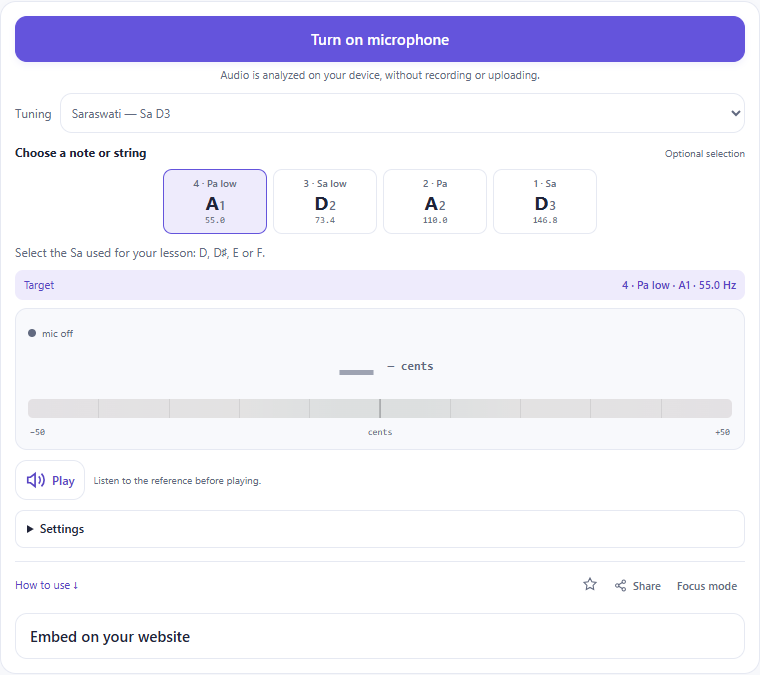
There are two ways to work. In Auto mode the tuner detects which of the four strings you played. If you tap a string button, the tuner plays that note and locks onto that string. Locking is safer on the two low strings, because a low note can be read in the wrong octave.
Tune the main strings step by step
Sit with the veena in your normal playing position, in a quiet room. Turn off fans and any other drone for a moment, so the microphone hears only your string.
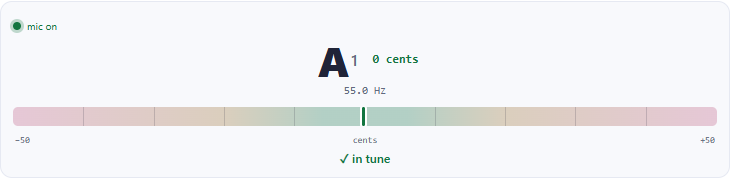
- Start with the 1st string. Tap "1 · Sa", allow the microphone and pluck the open string firmly. Do not touch the frets and do not pull the string sideways. Wait for the attack to pass and read the needle.
- Turn the peg slowly. Mala Viswanathan notes that turning a peg away from you raises the pitch and turning it toward you lowers it. Move it a little at a time; turning too far or too fast can break a string. If the string is sharp, go below the target and come back up to it.
- Use the fine tuners for the last step. If your veena has small metal rollers near the bridge, they work as fine tuners. In Mala Viswanathan's description, pushing a roller down raises the pitch and pulling it toward you lowers it.
- Tune the 2nd string. Tap "2 · Pa" and bring it to the Pa below your Sa (A2 with Sa D3).
- Tune the 3rd string. Tap "3 · Sa low" and bring it to Sa one octave below the first string (D2).
- Tune the 4th string. Tap "4 · Pa low" and bring it to Pa one octave below the second string (A1). This string is low and thick, so give it a strong pluck and a little more time.
- Go back to the 1st string. Raising tension on one string can change the others slightly. Check all four again before you play.
Tune the three tala strings
The three tala strings follow the same Sa. Sources agree on Sa, Pa and upper Sa. With Sa D3, that gives D3, A3 and D4.
| Your Sa | Sa | Pa | Upper Sa |
|---|---|---|---|
| D3 | D3 · 146.83 Hz | A3 · 220.00 Hz | D4 · 293.66 Hz |
| D♯3 | D♯3 · 155.56 Hz | A♯3 · 233.08 Hz | D♯4 · 311.13 Hz |
| E3 | E3 · 164.81 Hz | B3 · 246.94 Hz | E4 · 329.63 Hz |
| F3 | F3 · 174.61 Hz | C4 · 261.63 Hz | F4 · 349.23 Hz |
Mala Viswanathan describes the order on the instrument as: the top tala string to the Sa of the first string, the middle one to Pa, and the lowest one to the higher-octave Sa. Practice can vary between teachers and instruments, so follow yours if it differs.
The veena tuner has buttons only for the four main strings. The tala Sa is the same note as "1 · Sa", so you can check it with that button. For the Pa and the upper Sa, open the chromatic tuner, pluck one tala string at a time and read note, octave and cents. Mala Viswanathan suggests striking them one by one to check that they sound in agreement.
Check the tuning by ear on the frets
The Saraswati veena has 24 fixed frets, 12 for each octave, as the Sruti guide to the veena explains. Because of this, simple fret checks confirm your tuning. These are the checks Mala Viswanathan gives:
- 2nd string, 5th fret = 1st string open (both Sa).
- 3rd string, 7th fret = 2nd string open (both Pa), or 3rd string, 12th fret = 1st string open (both Sa).
- 4th string, 5th fret = 3rd string open (both Sa).
Play the two notes one after the other, then together. If you hear a slow "wah-wah" beat, the notes are close but not equal. Turn the peg very slightly until the beat slows down and disappears. You can also play a tanpura drone on your Sa and listen to each open string against it.
A note on Pa: the tuner shows equal-tempered targets. A pure fifth (3:2) is about 2 cents wider. If your ear or your teacher puts Pa slightly away from the centre mark, that is normal. Mala Viswanathan also recommends training your ear, not only watching a needle.
Common problems and quick fixes
- The reading jumps an octave. Low strings, especially the 4th, can be read one octave too high. Tap the string button to lock the tuner, pluck harder and wait for the sound to settle.
- The needle follows the drone, not my string. Stop the shruti box or tanpura for a moment, or put a finger lightly on the tala strings.
- The note moves while I play. A gamaka bends the pitch on purpose. Always tune the open string without any pull, then go back to practice.
- The string went out of tune again. New strings stretch, and changes in temperature and humidity move the pitch. Mala Viswanathan recommends tuning every day.
- The tuner says "not near any string". You may have the wrong preset, or the string is far from its target. Check the preset, or read the note in the chromatic tuner first.
Questions about veena tuning
What are the veena tuning notes?
Main strings, from the 1st to the 4th: Sa, lower Pa, lower Sa, lowest Pa. Tala strings: Sa, Pa, upper Sa. With Sa D3 that is D3 A2 D2 A1 and D3 A3 D4.
Does this work for a Rudra veena or vichitra veena?
No. These are different instruments with their own tuning and register. The presets cover only the four main strings of the Saraswati veena.
Which Sa should a beginner use?
Use the one your teacher uses. If you have no teacher yet, start with the default preset in the veena tuner and change it later when you play with others.