Twelve strings, six pairs
A bajo sexto has twelve strings, but you play them in six pairs. Each pair is called a course. From the lowest course to the highest, the notes are E, A, D, G, C and F. Every course is a fourth above the one before it. That even pattern makes the instrument easy to check once you know it.
The pairs are not all alike. In the three bass courses, E, A and D, the thick string gives the low note and its thin partner sounds one octave higher. Both strings share a letter, but not a pitch. In the three treble courses, G, C and F, both strings play the same note. That is called a unison. This layout matches the note chart that D’Addario publishes for its EJ86 bajo sexto string set.
If you want the quick version, open the bajo sexto tuner and follow the table below. The rest of this guide explains how to get each string right and how to confirm it by ear.
| Course | Main string | Partner string | Pair type |
|---|---|---|---|
| 6th: E | E1 · 41.20 Hz | E2 · 82.41 Hz | Octave |
| 5th: A | A1 · 55.00 Hz | A2 · 110.00 Hz | Octave |
| 4th: D | D2 · 73.42 Hz | D3 · 146.83 Hz | Octave |
| 3rd: G | G2 · 98.00 Hz | G2 · 98.00 Hz | Unison |
| 2nd: C | C3 · 130.81 Hz | C3 · 130.81 Hz | Unison |
| 1st: F | F3 · 174.61 Hz | F3 · 174.61 Hz | Unison |
The number after each letter is the octave. Middle C on a piano is C4, so E1 is very low. It is the same pitch as the open E string of a four-string bass guitar, one octave below the low E of a guitar. You do not need to memorize the hertz values. They help you notice when a reading lands in the wrong octave.
Tuning step by step with the online tuner
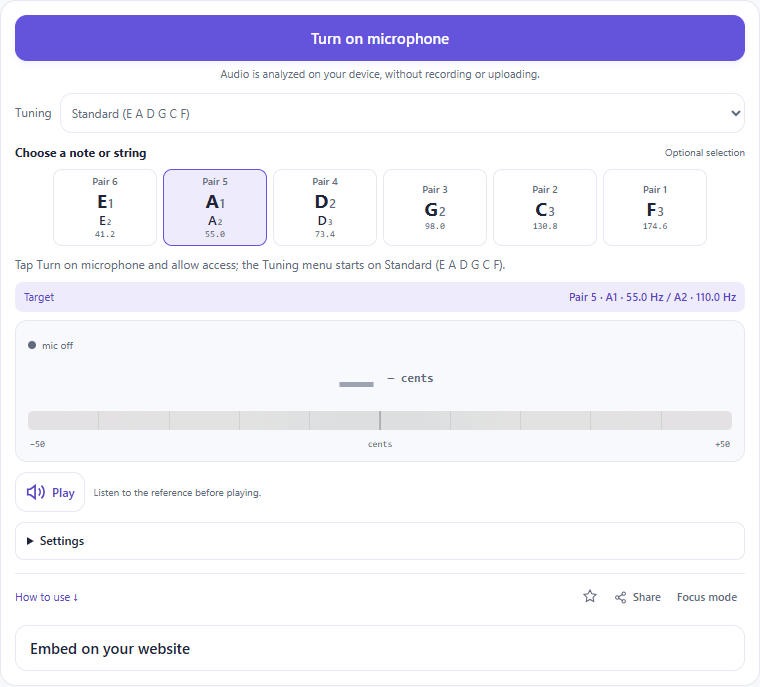
Open the Lalatone bajo sexto tuner on your phone or computer. In the Tuning menu, check that Standard (E A D G C F) is selected. Then tap Turn on microphone and allow access. Pick a quiet moment: if an accordion or a radio is playing nearby, the microphone hears it too.
The buttons above the reading show the six pairs. The highest number is the lowest course, so Pair 6 is E and Pair 1 is F. On the octave pairs, the button shows both notes. Tap a pair to hear its reference and lock the tuner to that course. For an octave pair you hear the low note first, then the high one. Wait until the sound stops before you pluck: the tuner ignores the microphone while its own reference is playing.
- Find the right peg. Follow the string with your eyes up to the headstock before you turn anything. With twelve pegs, it is easy to pluck one string and turn its neighbor.
- Mute the partner. Rest a fingertip lightly on the other string of the pair. Then pluck one open string and let it ring.
- Start with A. A phone hears the A pair more easily than the low E, so it makes a good anchor. Tune the thick string to A1 and the thin one to A2. On octave pairs the tuner says low string or high string (octave), so you can see which one it heard.
- Tune D, then E. Set the D pair to D2 and D3. For the E pair, tune the thin string to E2 first, then the thick one to E1.
- Finish G, C and F. Tune both strings of each pair to the same note: G2, C3 and F3. A pair gets a ✓ once its notes hold in tune, but pluck the second string anyway. The tuner knows the note, not which of the two strings you plucked.
- Go around again. Twelve strings pull hard on the neck. After big changes, the first pairs you tuned may have moved. Check all six again and play a chord you know.
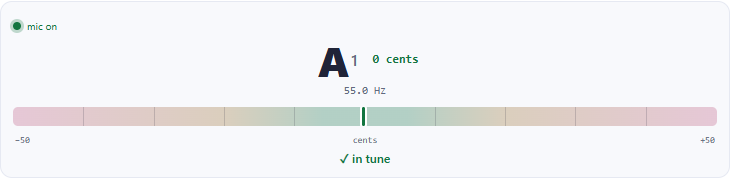
Follow the arrow. ↑ flat: tighten means the string is below the target, so raise it. ↓ sharp: loosen means it is above. The cents number tells you how far: negative is flat, positive is sharp. Make small turns and pluck again after each one. If you go past the note, drop slightly below it and come back up. Approaching from below helps the string stay in place.
How to check your tuning by ear
Octave pairs: the 12th fret harmonic
For E, A and D, touch the thick string lightly right above the 12th fret, without pressing it down. Pluck, then lift the finger. The bell-like note you hear is one octave above the open string. It should match the thin partner played open. Now you compare two sounds at the same pitch, which is much easier than judging an octave.
Unison pairs: listen for beats
For G, C and F, pluck both strings together. If you hear a slow “wah-wah-wah” pulse, the two strings are slightly apart. Those pulses are called beats. Keep one string where the tuner put it and turn the other one very gently. The beats slow down as you get closer and disappear when the pair is in tune.
Fret checks between courses
All six courses are a fourth apart, so the 5th fret of one course gives the next open course. Play the thick E at the 5th fret and compare it with the open thick A. Do the same from thick A to thick D, from thick D to G, from G to C and from C to F. Press with your normal playing pressure, not harder.
The thin octave strings have their own shortcut. At the 3rd fret, thin E2 gives G2, thin A2 gives C3 and thin D3 gives F3. Each one should match an open treble course exactly. This is a fast way to find one thin string that is off without retuning everything.
With a guitar nearby
A guitar in standard tuning gives you more references. Its open low E, A and D strings (E2, A2 and D3) are the same pitches as your thin E, A and D partners. Its 6th, 5th and 4th strings at the 3rd fret give G2, C3 and F3, the notes of your treble courses.
Common problems and how to fix them
The low E gives no reading, or the wrong one
E1 vibrates at about 41 Hz. Many phone microphones barely pick up a note that low. The tuner may also hear the string’s octave overtone and show E2. Pluck firmly near the phone, mute the thin partner and tap Pair 6 to lock the course. If it still struggles, tune the thin E2 first and set the thick string by ear with the 12th fret harmonic. Do not drop a string a whole octave because one reading came out high.
A thin octave string breaks
This usually happens when a string is pushed toward the wrong octave. If the thin D string reads near D2, it is not almost in tune: it is an octave low, or the tuner heard the thick string. Check which string you plucked, mute the other one, and compare the reading with the table before you tighten. Raising a string a full octave would need about four times its normal tension, and it will not survive that. Bring new strings up slowly and check the note on the way.
A pair still sounds wobbly after tuning
Each string can read in tune on its own while the pair still beats a little. For the last small step, trust your ears and adjust the second string against the first. Check that both strings sit properly in their slots at the nut and the bridge. Old strings often lose clarity and stop holding pitch. If one pair never sounds clean, try fresh strings.
Restringing and neck tension
D’Addario’s tension chart for the EJ86 set lists roughly 18 to 30 pounds per string. Across twelve strings, that adds up to a little over 300 pounds on the neck. When you restring, change one or two strings at a time, or bring all of them up in stages, so the neck is not loaded unevenly. New strings stretch, so expect to retune several times during the first day.
Open strings are right, but chords sound off
First, press more gently. Heavy pressure pulls fretted notes sharp. If the open strings are correct but notes go out at the same frets every time, the instrument may need a setup. A luthier can check string height and intonation. Turning a peg to fix one chord usually spoils the others.
The band sounds out of tune with you
Agree on one reference before rehearsal. The tuner uses A = 440 Hz by default, and you can change Reference A in its settings if your group tunes to another value. Everyone should tune to the same reference, not to each other one by one.
Bajo sexto, bajo quinto and 12-string guitar
The bajo quinto has ten strings in five pairs. It leaves out the low E course and keeps A, D, G, C and F, with A and D in octaves. Taylor describes the bajo quinto as an instrument that evolved from the bajo sexto by dropping that lowest course. If yours has ten strings, choose Bajo quinto (A D G C F) in the same Tuning menu, or open the bajo quinto tuner.
A 12-string guitar is a different instrument. It uses E A D G B E, with a smaller step between G and B, and its main strings sit an octave higher. The bajo sexto keeps a fourth between every course, so its top two courses are C and F instead of B and E. For that guitar, use the 12-string guitar tuner.
Quick answers
What are the bajo sexto tuning notes?
From bass to treble: E1 and E2, A1 and A2, D2 and D3, then G2, C3 and F3 with both strings on the same note.
What is bajo sexto tuning in English note names?
In Spanish names it is Mi, La, Re, Sol, Do, Fa. In English letters it is E, A, D, G, C, F. The tuner can show either one: set Note names to Do Re Mi if you prefer Spanish.
Which pair should I tune first?
Start with A. It is a clear, steady note for a phone microphone, and the fret checks work outward from it in both directions.
Do I need to install an app?
No. The bajo sexto tuner runs in the browser on Android and iPhone. Add it to your home screen and it opens like an app.