What you are tuning: three playing strings and many tarabs
A classical Hindustani sarangi has three thick gut playing strings that you bow and stop with your fingernails, and a large set of thin metal sympathetic strings, called tarabs, that ring when you play. The best detailed description we know is in Joep Bor's study The Classical Sarangi. It names the playing strings like this:
- First string (sur, tip or jil): the highest. This string carries your Sa.
- Middle string (pancham or dor): usually Pa below that Sa.
- Lowest string (kharaj): Sa, one octave below the first string.
Bor describes the tarabs of the classical sarangi in three groups:
- Main tarabs (andheri ki tarab): 15 strings, tuned from the two back rows of small pegs on the right side of the neck.
- Right-hand tarabs: 9 strings, tuned from the front row of small pegs.
- Upper tarabs (jivari tarabs): 11 strings, tuned from pegs in the upper pegbox, in groups of five and six.
There is also one twisted brass string, the laraj, in the main pegbox. Bor explains that it works as the ground note for the sympathetic system. The number of tarabs changes from one instrument to another, so count the pegs on your own sarangi and make a map before you start.
Some instruments with the same name are different. The Nepali sarangi is a smaller four-string fiddle, and the Punjabi chhoti sarangi is a folk instrument. The Horniman Museum record of a chhoti sarangi describes three playing strings and thirteen tarabs, tuned with a digital tuner or a harmonium. This guide is about the large classical sarangi. For the other types, ask your teacher for the notes and read them in the sarangi tuner.
Choose Sa before you touch a peg
There is no single concert pitch for the sarangi. You tune it to a Sa that you, your teacher or your singer chooses. Bor writes that the sarangi can be tuned from C♯ to F♯, and that it sounds best with the first string on D♯ or E. He also explains that an accompanist must follow the singer's pitch. When that pitch is too high for the instrument, as often happens with women singers, the player uses the middle string as the new Sa instead.
George Howlett's informal survey of Sa in recordings gives a similar picture for solo sarangi: most of the recordings he checked were around D♯, some at D and E. His survey also notes that players who accompany female vocalists sometimes move Sa to the Pa string.
So the first step is a reference: a tanpura, a shruti box, a harmonium or the singer's voice. If you have none, the online tanpura can give you a steady Sa drone.
Notes and frequencies for the playing strings
Bor describes two basic systems for the playing strings. The most common is chargha: Sa, Pa, upper Sa from the lowest string up. The other is Sa–Ma–Sa, with Ma on the middle string. The table shows both with Sa = E3 on the first string. This is an example, not a rule: your Sa may be different. Notes use scientific octave numbers (middle C is C4) and A4 = 440 Hz in equal temperament.
| String | Chargha (Sa–Pa–Sa) | Sa–Ma–Sa |
|---|---|---|
| 1st, sur | Sa · E3 · 164.81 Hz | Sa · E3 · 164.81 Hz |
| Middle, pancham | lower Pa · B2 · 123.47 Hz | lower Ma · A2 · 110.00 Hz |
| Lowest, kharaj | lower Sa · E2 · 82.41 Hz | lower Sa · E2 · 82.41 Hz |
With Sa = D♯3, chargha becomes D♯3 (155.56 Hz), A♯2 (116.54 Hz) and D♯2 (77.78 Hz). In the Sa–Ma–Sa system the middle string is G♯2 (103.83 Hz). Whatever your Sa, the shape stays the same: the kharaj is one octave below the first string, and the middle string is a fifth (Pa) or a fourth (Ma) above the kharaj.
Bor adds that when Sa moves to the middle string, chargha becomes Ma–Sa–Ma and the Sa–Ma–Sa system becomes Pa–Sa–Pa. Some players lower the kharaj by a whole tone to reach lower notes. If your teacher uses one of these, write it down with the octave of each string.
Set up the tuner
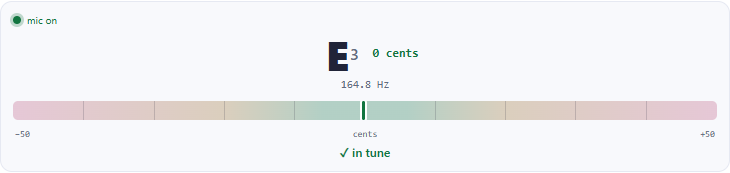
The sarangi tuner is a chromatic tuner. It has no fixed buttons for each string, because the right notes depend on your Sa. It shows the nearest note with its octave, the frequency in Hz and how many cents you are away from that note.

Two more settings are useful with this instrument. Hold the last reading keeps the last note on the screen after a plucked tarab fades. Sensitivity lets you choose "high" for soft strings or "low" for a noisy room.
Tune the playing strings step by step
- Write your targets. Note the Sa, the system (chargha or Sa–Ma–Sa) and the three target notes with octaves, for example E3, B2, E2.
- Allow the microphone and bow the first string open. Keep your fingernails completely away from the string. Use a long, even bow stroke and read the note only after the sound is steady.
- Turn the large peg slowly. If the string is sharp, go a little below the target and come back up. Small turns are enough near the target.
- Tune the middle string to Pa (or Ma) below your Sa, with the same steady bow.
- Tune the kharaj to Sa one octave below the first string. Check the octave number on the screen: E2, not E3.
- Bow the three strings again. Changing tension on one string can move the others, so repeat until all three stay in place.
Tune the tarabs, one group at a time
The tarabs are where sarangi tuning really changes from player to player. Bor gives these patterns:
- Main tarabs: tuned chromatically, in semitone steps. The lowest string starts at komal Dha or komal Ni, depending on the string gauge, and each next string goes one semitone up. Because this scale does not change with the raga, players call it achal that.
- Right-hand tarabs, solo playing: tuned to the notes of the raga, starting from Sa. For Kafi that, Bor gives Sa Re Ga Ma Pa Dha Ni Sa Re, with Ga and Ni komal as Kafi requires.
- Right-hand tarabs, accompaniment: often tuned chromatically too, so the player can follow any raga the singer chooses and change Sa with little retuning.
- Upper tarabs: tuned to melodic patterns that depend on the raga and on the player's taste. Bor shows different examples from different masters, so there is no standard table.
Bor also describes the order that sarangi players follow. After the playing strings, the player places the sarangi flat on the lap and tunes the upper tarabs from left to right, using a tuning key and plucking each string with the nail of the right index finger. Next come the right-hand tarabs, then the main tarabs. Then the player checks the playing strings and repeats the whole round several times. Bor writes that, in good conditions, this takes five to ten minutes.
With the tuner, pluck one tarab lightly and read it alone. Let it fade before you pluck the next one. If many strings ring together, the tuner cannot tell which string you mean, so damp the others with your hand. Keep a written map with each peg, its note and its octave.
Check by ear and fix common problems
A tuner gets you close. The final check is the sound of the instrument. Play the tanpura on your Sa and bow each open playing string against it; a slow beat means the string is still a little off. Then bow notes on the first string and listen: when a tarab matches the note you play, the sound becomes fuller and rings after you stop. If a note sounds dry where it should ring, check the tarab for that note.
- Right letter, wrong octave. Do not keep tightening a string because the letter looks right. Check the octave number against your written targets.
- The reading jumps around. Tarabs are ringing. Damp them while you tune the playing strings, and keep the bow stroke steady.
- The note is sharp only when I play. Your fingernail may be touching the string, or you are pressing it sideways. Tune open strings only.
- Equal temperament vs. raga. The tuner shows equal-tempered notes. For tarabs and raga notes, your ear and your teacher decide the final position; a few cents away from zero can be correct.
- The pitch keeps drifting. Gut strings react to temperature and humidity. Retune at the start of each session.
Questions about sarangi tuning
Is there a standard sarangi tuning chart?
Only for the relationships, not for absolute pitch. The playing strings follow Sa–Pa–Sa or Sa–Ma–Sa around your chosen Sa. The tarabs follow the patterns above, and the upper ones change with the raga.
How do I tune a Nepali sarangi?
It is a different four-string instrument, and this guide does not cover its tunings. Get the four notes from your teacher, then check each string in the sarangi tuner.
Can the tuner tune all the tarabs at once?
No. Read each string alone, then check the resonance by bowing. Many strings ringing together give no clear reading.