Saz, bağlama and the three courses
Bağlama and saz name the same family of Turkish long-necked lutes. People often use bağlama for the standard size and saz for the family as a whole. Almost every instrument in the family groups its steel strings into three courses, and Turkish players name them by position, not by pitch:
- Alt (lower): the course nearest the floor when you hold the instrument. Most melodies are played here.
- Orta (middle).
- Üst (upper): the course nearest your face.
A course can have two or three strings. On many instruments the alt and üst courses also have a bam: a thicker, wound string tuned one octave below the others in its course. So seven strings do not mean seven notes. In the common seven-string layout there are only three note names, spread over a few octaves.
The online saz and bağlama tuner follows this physical order. Its buttons read Upper, Middle and Lower, and each string has its own target, so you can check the bam and the steel strings separately.
The neck matters too. Long-neck instruments (uzun sap) are commonly played in bozuk düzen, while short-neck instruments (kısa sap) more often use bağlama düzeni. That is a habit, not a rule: repertoire, region and teacher can change it, as the maker Sala Müzik explains in its tuning guide.
Bozuk düzen notes: La, Re, Sol
In bozuk düzen (also called kara düzen) the courses read La–Re–Sol from lower to upper: A on the alt course, D on the orta course and G on the üst course. The table shows the seven-string example used by the tuner, at A4 = 440 Hz. The octave numbers follow scientific pitch notation, where C4 is middle C.
| Course | Tuner button | Note | Frequency |
|---|---|---|---|
| Üst (upper) | Upper: bass | G2 · Sol | 98.00 Hz |
| Üst (upper) | Upper: treble | G3 · Sol | 196.00 Hz |
| Orta (middle) | Middle: 1 | D3 · Re | 146.83 Hz |
| Orta (middle) | Middle: 2 | D3 · Re | 146.83 Hz |
| Alt (lower) | Lower: bass | A2 · La | 110.00 Hz |
| Alt (lower) | Lower: treble 1 | A3 · La | 220.00 Hz |
| Alt (lower) | Lower: treble 2 | A3 · La | 220.00 Hz |
Three details are worth noticing before you turn a peg:
- The pitch does not rise from one course to the next. The middle course, D3, is the lowest of the steel strings. The alt course, A3, is the highest. This kind of tuning is called re-entrant.
- The bams are one octave lower. G2 sits under G3 and A2 under A3. Never pull a bam up to the pitch of its steel partner: it would be a whole octave too high.
- The middle pair is a unison. Both orta strings are D3.
The same note names are listed for this layout in the SMCore instrument database, which also shows bozuk düzen at other pitch levels. If you think in solfège, the mapping is Do = C, Re = D, Mi = E, Fa = F, Sol = G, La = A and Si = B. The tuner can show either system; in its Do Re Mi option, B appears as Ti.
Bağlama düzeni and the other düzens
Bağlama düzeni reads La–Re–Mi from lower to upper. The Turkish Ministry of Culture describes it in its page on the bağlama: the bottom group tuned to La, the middle to Re and the top to Mi. Compare it with bozuk: the alt and orta courses keep the same names, and only the üst course changes, from Sol (G) to Mi (E).
The octave of that E, and of the other strings, depends on your instrument and string set. Short-neck instruments, where bağlama düzeni is most common, are often strung differently from a long-neck saz in bozuk. The tuner has no separate bağlama düzeni profile, so do not invent one by transposing the bozuk example: the relation between the courses is different. Instead:
- Ask your teacher or the maker which octave each string should sound in.
- Open the saz tuner and choose the profile Free chromatic / manual target.
- Set the chosen note and octave for one string, tune it, then move on to the next string.
There are many more düzens. The Ministry lists kara, misket, müstezat, abdal and rast among the alternatives, and each is linked to particular regions and repertoires. The same free mode works for all of them once you know the notes. If you play the small, high cura, use the cura saz tuner instead: in bozuk it sits one octave above the bağlama.
Why your teacher's “La” may not be A
In everyday Turkish practice, the names of a düzen describe a pattern. The alt course is called La, the others are named from it, and players then tune the whole instrument higher or lower so that the karar (the tonic, the note where a melody comes to rest) suits a singer or an ensemble. Sala Müzik describes this shift of the overall pitch, and the SMCore database lists the same long-neck bozuk layout with the lower course on A, B, C or D.
So when a lesson says “tune the alt to La”, that La may sound as B or C on a chromatic tuner. Both descriptions can be correct at once: one names the pattern, the other names the real pitch.
The tuner handles this with Transpose (semitones). Keep the bozuk profile and add semitones to raise every target together: +2 puts the alt course on B, +3 on C and +5 on D. The relations between the courses stay the same. Raise the pitch only if your strings and instrument are meant for it: a higher level means more tension on the neck and soundboard.
If you need to match another instrument instead of a named pitch level, set A4 or use Capture reference. In a string profile, capture recalculates A4 from the first target, Upper: bass, so play that note before capturing.
Tune a bağlama step by step with the tuner
Find a quiet room and hold the instrument as you would to play. Pluck with your usual plectrum (tezene), gently, and let each string ring.
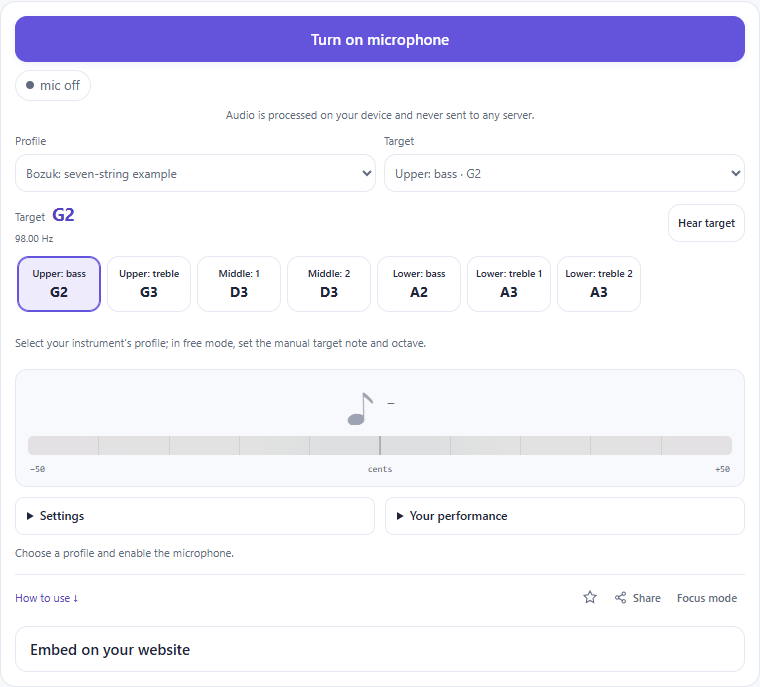
- Choose the profile. For a long-neck saz in bozuk, pick Bozuk: seven-string example. Leave A4 at 440 Hz and Transpose at 0 unless you play at another level.
- Turn on the microphone and pick a target, for example Upper: bass. Use Hear target to hear the note, then stop the sound before you measure.
- Mute the other strings of the course. Rest a finger lightly on the strings you are not tuning, and pluck one open string.
- Read the note, the octave and the cents. Below the target, tighten a little; above it, loosen. Approach the note from below, so the string settles under tension.
- Repeat for all seven targets. Start with the bams if you like: they are the easiest to confuse with their octave partners.
- Go round again. Tuning one string changes the tension on the neck slightly, so the first strings may have moved.
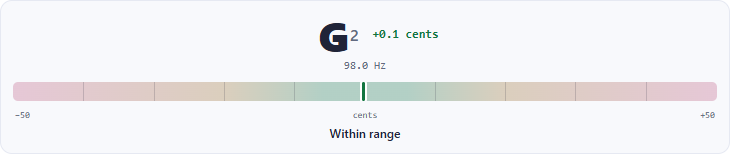
A bam string has a strong overtone one octave up. If the reading jumps between G2 and G3, pluck more softly, a little further from the bridge, and wait a second after the attack.
Then check the tuning by ear
When every target is close, listen to the instrument as a whole:
- Unisons. Play the two orta strings together, then the two steel strings of the alt course. If you hear a slow “wah-wah” beating, the strings are slightly apart. Turn one of them very gently until the beating slows down and disappears.
- Octaves. Play each bam with its steel partner. A good octave sounds like one rich note; a rough, wavering sound means one of them is off.
- Open courses together. In bozuk, orta and alt make a fifth (D–A), orta and üst make a fourth (D–G), and üst and alt are a whole tone apart (G–A). In bağlama düzeni, orta and üst are a whole tone apart (D–E) and üst and alt make a fourth (E–A).
Avoid tuning by fret positions alone. The bağlama has extra frets for microtonal intervals, and the tuner only checks the open strings, not every pitch of a makam.
Common tuning problems
The pegs slip back
Wooden friction pegs hold by pressure. Push the peg gently into its hole while you turn, and make small movements. If a peg still slips, or sticks and then jumps, ask a maker to check its fit; do not force it. Many newer instruments have geared tuners, which hold more easily.
New strings will not stay in tune
New steel strings stretch during the first days. Tune, play for a while, and tune again. Make sure each string is wound neatly around its peg, since a loose winding can slip.
The tuning changes from room to room
The body and neck are wood, so heat, cold and humidity change the tension. Let the instrument settle for a few minutes after a change of room before the final check.
The display shows the right note in the wrong octave
Check the octave number, not only the letter. For A, the steel strings of the alt course read A3 and the bam reads A2. Do not tighten a string by a whole octave to follow an unstable reading: mute the other courses and play again.
Quick answers
My saz has six strings. Which tuning do I use?
Many saz have six strings in three pairs. Look at the gauges: a clearly thicker, wound string is a bam and sounds an octave lower than its partner. Tune each string to the note of its course in the right octave, choosing targets from the bozuk profile or using free mode.
Is the Greek baglamas the same instrument?
No. The Greek baglamas is a small bouzouki with its own tuning, D–A–D. Use the Greek baglamas tuner for it.
Which düzen should a beginner learn?
Follow your teacher or method book. With a long-neck saz, that is often bozuk düzen; with a short-neck instrument, often bağlama düzeni. When you know the düzen and its pitch level, go back to the saz tuner and check each string before you play.