How the 21 kora strings are arranged
The kora is the 21-string harp of the Mande griots, the jalis of The Gambia, Senegal, Guinea, Guinea-Bissau and Mali. Its strings run in two rows, one on each side of a tall bridge. You hold the kora facing you and play the left row with your left hand and the right row with your right hand.
The Lalatone kora tuner names the strings by side and position. ←1 to ←11 are the eleven strings on the left side and →1 to →10 are the ten strings on the right side. On each side, number 1 is the string nearest to you and the numbers rise as you move away from your body. This matches the usual diagrams, which show the bridge from above as the player sees it: the two strings closest to you, ←1 and →1, are both F.
The scale does not run up one side and then the other. It zigzags. After the bass notes on the left (←1 to ←4), the scale alternates hands: F3 on the right (→1), G3 on the left (←5), A3 on the right (→2), and so on up to A5 at →10. This is why it is easy to tune the wrong string: always count from the string nearest to you.
Leather rings or guitar machine heads
A traditional kora holds each string with a konso, a leather ring around the neck; you change the tension by moving the ring along the neck. The Kora Café calls the konso system quite tricky to tune and says it takes practice, and its buying guide notes that most Western players prefer koras with tuning pegs. Many modern koras use guitar machine heads, which are quicker to tune and allow small, precise changes, useful when you switch from Silaba to Sauta before a song. The tuner works the same with both; with leather rings, move them in small steps and pluck again after each change.
Kora notes and frequencies in modern F tuning
Many modern players, especially outside West Africa, tune the kora to an F major scale in equal temperament, because it makes it easy to play with guitars, keyboards and other instruments. The Kora Café tuning guide calls F tuning a recent development and says F is the most common base note, although other base notes are possible. The table follows the tool's "Modern F major — 21 strings" profile, with C4 as middle C and A4 = 440 Hz.
| Left string | Note | Hz | Right string | Note | Hz |
|---|---|---|---|---|---|
| ←1 | F2 | 87.31 | →1 | F3 | 174.61 |
| ←2 | C3 | 130.81 | →2 | A3 | 220.00 |
| ←3 | D3 | 146.83 | →3 | C4 | 261.63 |
| ←4 | E3 | 164.81 | →4 | E4 | 329.63 |
| ←5 | G3 | 196.00 | →5 | G4 | 392.00 |
| ←6 | B♭3 | 233.08 | →6 | B♭4 | 466.16 |
| ←7 | D4 | 293.66 | →7 | D5 | 587.33 |
| ←8 | F4 | 349.23 | →8 | F5 | 698.46 |
| ←9 | A4 | 440.00 | →9 | G5 | 783.99 |
| ←10 | C5 | 523.25 | →10 | A5 | 880.00 |
| ←11 | E5 | 659.26 |
Some diagrams label the lowest string "F0" or use small numbers to count octaves from the lowest note. That is a counting system for the kora, not the scientific octave F0. On a kora tuned to F, the lowest string ←1 is usually F2, about 87 Hz, a semitone above the low E of a guitar.
Tomora Ba, Silaba, Hardino, Sauta: what changes
Kora players speak of several traditional tunings. The names and even the number of tunings vary: the Kora Café notes that some players recognize four, others three or two. The four names you will meet most often are below.
- Tomora Ba ("great Tomora"), also called Silaba. The notes to the Smithsonian Folkways album Gambian Griot Kora Duets describe it as probably the original kora tuning, the closest of the four to a just scale, linked to the coastal region south of the River Gambia. Today's teaching sites usually present Silaba as the F major tuning in the table above.
- Hardino. The same notes describe it as derived from Tomora Ba, with the intervals between the 2nd and 3rd and between the 6th and 7th notes of the scale made wider. They quote a description of Hardino as virtually identical to the Western major scale.
- Tomora Mesengo ("lesser Tomora"). Also derived from Tomora Ba, but with those same two intervals made narrower.
- Sauta. Derived from Hardino by raising the 4th note of the scale. On a kora based on F, the 4th is B♭, so in Sauta the two B♭ strings become B natural. Kora teacher Josh Doughty sums it up in modern terms: Silaba has the notes of F major and Sauta has the notes of C major, and the B strings are the only ones that change.
Two points are important. First, the traditional tunings were not built on equal temperament, so a modern F major or Sauta profile is an adaptation, not a measurement of how a particular jali tunes. Second, the sources do not agree on everything: the Folkways notes connect the Western major scale with Hardino, while modern teaching sites connect F major with Silaba. If you learn from a teacher, use their names and their notes.
Which profile to choose in the tuner
The tuner has three profiles. They are the same layout of 21 strings; only the target notes change.
- Modern F major — 21 strings. The table above. Use it for Silaba as it is usually taught today and for playing with Western instruments.
- Modern Sauta — 21 strings. Identical, except that ←6 is B3 (246.94 Hz) instead of B♭3 and →6 is B4 (493.88 Hz) instead of B♭4. To switch from Silaba to Sauta, you only retune these two strings.
- Free reference — choose note and octave. No fixed list: you choose the note and octave for each string. Use it for Hardino, Tomora Mesengo, a personal tuning or the notes your teacher gave you. The tuner has no separate Hardino or Tomora Mesengo profile.
Not every kora is tuned to F. Josh Doughty notes that the two lowest strings may be E, F, F♯, G or A, and that the whole scale moves with them. In the modern profiles, use Transpose (semitones) in Settings: −1 for E, +1 for F♯, +2 for G, +4 for A. Every target moves by the same amount.
Traditionally, as the Kora Café explains, the kora was tuned relative to its lowest string, which was matched to a singer's voice or to a balafon. The tuner can do the same with Capture reference: tune ←1 where you want it, play it steadily, and press Capture reference in Settings. The tuner takes that note as the base and recalculates all the other targets from it. Capture always uses the first target of the profile, ←1, even if another string is selected. In Free reference mode, choose the note and octave first.
Step by step with the Lalatone kora tuner
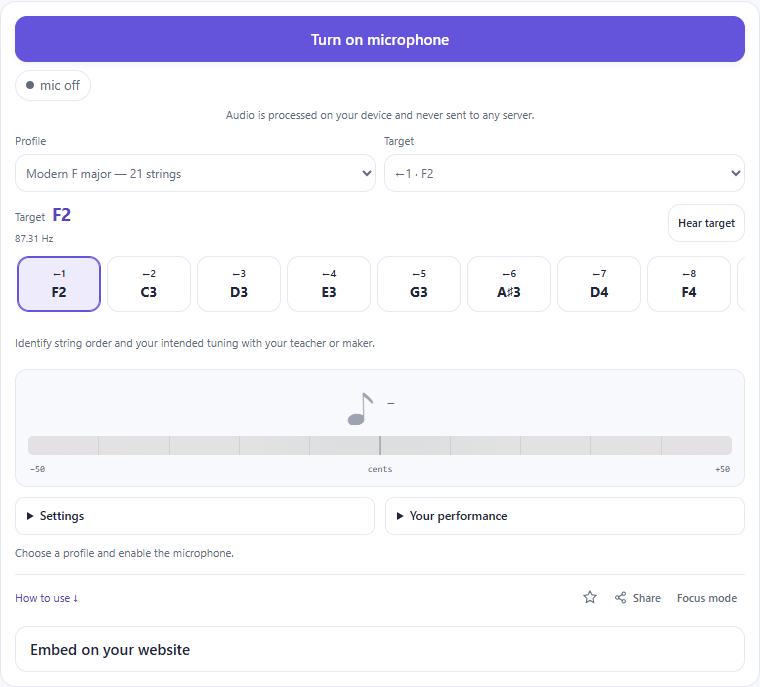
- Choose the profile. Open the kora tuner and pick Modern F major, Modern Sauta or Free reference. Set Transpose and Reference A in Settings only if you need them.
- Turn on the microphone. The Kora Café suggests a clip-on chromatic tuner on the gourd; with a phone, hold it close to the gourd and keep the room quiet.
- Start with ←1. Tap the ←1 button, or choose it in Target. The target shows F2 and 87.31 Hz. Press Hear target if you want to hear the note first.
- Pluck one string at a time. Damp the strings next to it with your other hand so they don't ring together. Wait a moment after the attack: the first part of the sound is the least stable.
- Adjust slowly. "Below target" means tighten; "Above target" means loosen. Make small turns and let the string settle before you pluck again.
- Work through both sides. A practical order is to follow the scale: the bass strings ←1 to ←4, then →1, ←5, →2, ←6 and so on. With Target on Automatic, the tuner follows the closest string in the profile.
- Go round a second time. All 21 strings pull on the same neck and bridge. After the first pass, the first strings you tuned may have moved slightly.
Reading the display and checking by ear
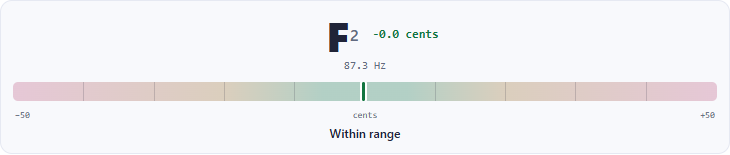
The display shows the note heard, the frequency, a needle with the difference in cents, and a message: "Below target", "Above target" or "Within range". Check the octave number too. The kora has the same note in several octaves, so an F that reads F3 when you wanted F2 means you are playing →1 instead of ←1.
Octaves are the best way to check your work by ear, because the kora has many of them. These groups should sound like the same note in different registers:
- F: ←1, →1, ←8, →8
- C: ←2, →3, ←10
- D: ←3, ←7, →7
- E: ←4, →4, ←11
- G: ←5, →5, →9
- A: →2, ←9, →10
- B♭ (or B in Sauta): ←6, →6
Pluck two strings of the same group one after the other, then together. If you hear a wave or beating, one of them is slightly off; the tuner tells you which.
Common problems and quick answers
- The kora goes out of tune quickly. Josh Doughty recommends tuning before every session, ideally every day in humid climates. A kora that has not been played for a long time is harder to tune and takes longer to settle.
- The tuner shows the wrong note. Another string is ringing. Damp the neighbors and pluck again.
- My kora has 22 strings. Josh Doughty describes the extra string on the right side, just below the lowest note, tuned to B♭. The tool profiles have 21 strings; tune the 22nd in Free reference mode with the note and octave your teacher or maker gives you.
- Must every kora be tuned to F? No. F is common today, but the base note depends on the instrument, the strings and the music. Use Transpose or Capture reference.
- How long does it take to tune a kora? It depends on the tuning system and how far the strings have moved. Machine heads are quicker than leather rings, and daily tuning keeps the changes small.
- Can I use a guitar tuner? Only a chromatic one, which shows every note. A tuner limited to the six guitar strings will not show the kora notes.
For your next session, open the kora tuner, choose Silaba (Modern F major) or Sauta, tune ←1 first, and finish with the octave checks. If you also play other harps, the harp tuner uses the same idea of one note per string.