Erhu notes: inner D4 and outer A4
The erhu has two strings and no fingerboard. The inner string is the one closer to your body when you hold the instrument, and it is tuned to D4, the D just above middle C. The outer string is tuned to A4, a perfect fifth higher. Erhu performer and composer Lan Tung gives exactly these pitches and explains that the D string is called the inside string because it sits closer to the player.
Before you touch a peg, open the erhu tuner and listen to both notes. The table uses scientific octave numbers, where C4 is middle C, and the common reference A4 = 440 Hz. If your teacher, orchestra or recording uses another reference, use the same one.
| String | Note | Frequency | Number in a 1=D score |
|---|---|---|---|
| Inner string (closer to you) | D4 | 293.66 Hz | 1 |
| Outer string | A4 | 440.00 Hz | 5 |
Many erhu scores are written in jianpu, the numbered notation. The key mark at the top tells you what the numbers mean. In a piece marked 1=D, D is 1, so the open inner string is 1 and the open outer string is 5. In 1=G the same open strings are 5 and 2, and in 1=F they are 6 and 3. The open pitches do not change: the key mark changes your finger positions, not your tuning. Only retune when the score or your teacher asks for different open strings.
If you also play the violin, you already know these two notes: D4 and A4 are the two middle strings of the violin. That makes a violin, a piano or any chromatic tuner a good source of reference notes.
Pegs, fine tuners and the qianjin
Three parts of the erhu affect the pitch of the open strings. Knowing what each one does saves time and protects the strings.
Tuning pegs: for large changes
The pegs at the top of the neck hold the string by friction. Use them when a string is far from its note, for example after you fit a new string. Eason Music School's setup guide recommends turning the pegs inward, towards the neck, when you tighten, because this helps them hold. Turn slowly and in small steps. A friction peg often jumps past the note: you tighten a little too much, loosen it, and now the string is flat again.
Fine tuners: for the last few cents
This is why many players fit fine tuners, small metal adjusters attached to the strings. As Eason Music School describes, turning the knob or screw increases or releases the tension on the string, so the pitch moves by a small amount. The same article shows a second option without metal: a loop of qianjin cord tied around the neck and one string. Sliding that loop up pulls the string slightly and raises the pitch.
A good routine is: peg until the tuner shows the right note and is close to the center, then fine tuner to finish. If the fine tuner screw is at the end of its travel, turn it back to the middle and make the bigger change with the peg.
The qianjin is part of the tuning
The qianjin is the cord that pulls both strings towards the neck. It marks the top of the part of the string that vibrates, so moving it changes the pitch of both strings. Eason Music School explains in its guide to tying the qianjin that its position depends on the length of your arm, and that the tension where it pulls the strings matters: with too little tension, a push stroke and a pull stroke on the same open string can give different pitches. If the qianjin frays or becomes loose, retie it and tune again afterwards.
Bridge, damper and mute
The small bridge stands on the snakeskin and carries both strings. Under the strings, below the bridge, sits a damper, usually a piece of felt or foam. If the bridge has moved or leans after a string change, set it upright first and then tune, because the tension and the tone change when the bridge moves. If you practice with a mute, check the tuning again with the setup you will actually perform with.
Step by step with the Lalatone erhu tuner
- Choose the reference. The tuner starts at A4 = 440 Hz. Open Settings and change Reference A only if your group uses another value, such as 442 Hz.
- Turn on the microphone. Hold the phone near the instrument, but do not rest it on the snakeskin or the sound box. A quiet room helps a lot.
- Select Inner D. The standard tuning shows two buttons, Inner D and Outer A, each with its note and frequency. Tap Inner D: the tuner locks on D4, 293.66 Hz. Press Play string to hear the target before you bow.
- Bow the open inner string. Use a slow, even stroke at your normal practice volume, with no vibrato and no fingers touching the string. Read the pitch after the start of the stroke, when the sound is steady.
- Follow the message. "Flat: tighten" means the string is low; "sharp: loosen" means it is high. Use the peg if the string is far away and the fine tuner when it is close. Stop when you see "in tune", then bow again in both directions to confirm.
- Repeat on Outer A. Tap Outer A, check the target A4, 440 Hz, and tune the outer string the same way.
- Go back to the inner string. Both strings share the qianjin and the bridge, so changing one string can move the other a little. The counter shows how many of the two strings are in tune.
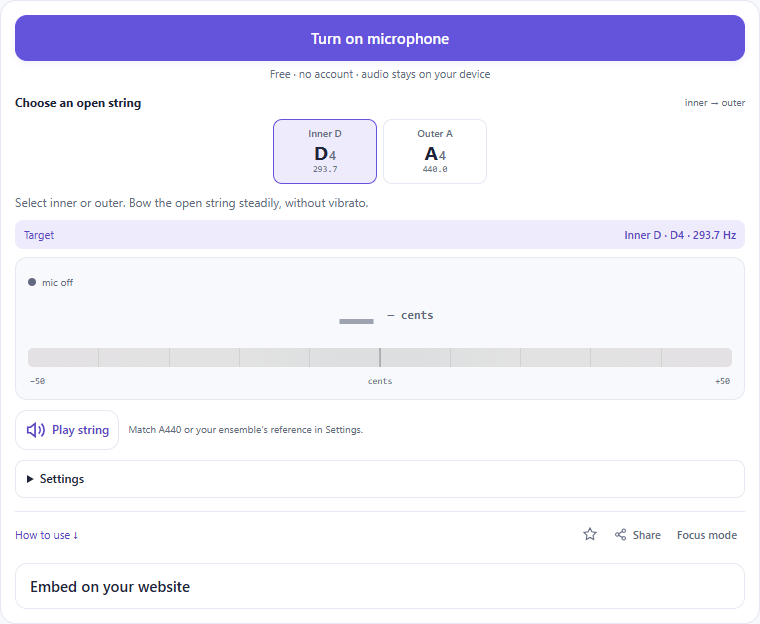
When you want the tuner to recognize whichever string you play, choose Auto in Settings. This is useful for a final check: bow inner, then outer, and watch both readings without tapping any button.
How to read the display
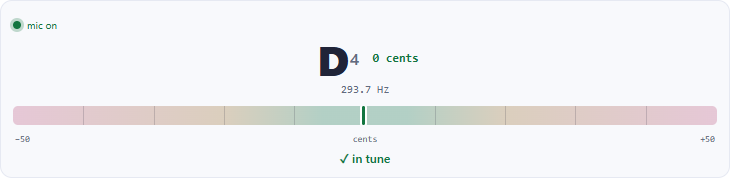
The tuner shows the note it hears with its octave number, the frequency in hertz and a needle with the difference in cents. One cent is a hundredth of a semitone. When the needle is centered and the reading says "in tune", the open string matches the target.
Pay attention to the octave number. On the inner string you want D4, not D3 or D5. A wrong octave usually means the microphone caught a scratchy start or a harmonic; bow again more evenly. A needle that moves a little at the start of each stroke is normal. A needle that never settles usually points to vibrato, a finger touching the string or an uneven bow, not to a tuning problem.
Check the tuning by ear
A tuner is fast, but your ear decides how the music sounds. These three checks take less than a minute.
- Against the reference tone. Press Play string and bow the same string while the tone sounds. If you hear a slow wave or beating, the two pitches are still slightly different. The beating gets slower as you get closer and disappears when they match.
- Between the open strings. Bow the open inner string, then the open outer string. The jump is a perfect fifth, the same as the first two different notes of "Twinkle, Twinkle, Little Star". If the fifth sounds narrow or wide, one of the strings has moved.
- With a fingered note. Find A4 on the inner string, the note 5 in a 1=D score, and compare it with the open outer string. They should sound the same. If they don't, check first the open strings and then your finger position, since the erhu has no fingerboard to fix the note for you.
You can also take the notes from another instrument. Check a violin's D and A strings with the violin tuner, or play D4 and A4 on a piano, and match the erhu to them.
Common problems and how to fix them
- The push stroke and the pull stroke give different pitches. Check the qianjin. Low tension at the point where it pulls the strings causes exactly this. Retie it if it is loose or frayed, then tune again.
- The peg slips back. Turn it inward, towards the neck, as you tighten, and check that the string is wound neatly. If it still slips, ask a teacher or repair shop to look at the peg.
- You keep going past the note. Leave the peg close and use the fine tuner or a qianjin-cord adjuster for the last step.
- New strings keep going flat. New strings stretch for a while. Tune, play for a few minutes, and tune again. Repeat during the first days.
- The open strings are right, but the melody is out of tune. Then the problem is finger position, pressure or vibrato, not tuning. Don't move the pegs to correct a fingered note.
- The tuning changes from day to day. Temperature and humidity affect strings and skin. Tune at the start of each practice session, in the room where you will play.
Some pieces use other open strings. For Erquan Yingyue, for example, players may tune lower to G and D, but Eason Music School explains in its article on lowering the pitch that this uses special, slightly thicker strings: if you only loosen normal D–A strings too much, the low tension causes poor tone, low volume and unstable pitch. The Lalatone erhu tuner keeps the standard D4–A4 preset. For a special setup, follow your teacher's notes and check each string with the chromatic tuner.
Quick answers
What notes is an erhu tuned to? Inner string D4 and outer string A4. With A4 = 440 Hz, that is 293.66 Hz and 440 Hz.
Which string is the inner string? The one closer to you in playing position. It is the lower one, D.
Should I tune to 440 or 442 Hz? Use the same reference as the people or recording you play with. On your own, 440 Hz is a common choice.
Do I need to retune for a piece in 1=G? Usually not. The numbers move to different fingers; the open strings stay D4 and A4 unless the score says otherwise.
Can I tune by plucking the strings? Plucking helps you find the note, but finish with a steady bow stroke, because that is how the string sounds when you play.
Keep the Lalatone erhu tuner open at the start of your next practice. Tune the inner D, then the outer A, check the fifth by ear, and you are ready to play.