Ten strings, five pairs
The modern Puerto Rican cuatro has ten steel strings, played in five pairs. Each pair is called a course. From the lowest course to the highest, the notes are B, E, A, D and G. Each course is a fourth above the one before it. Players usually count the courses from the top: the G pair is the 1st course and the B pair is the 5th.
The two bass courses are tuned in octaves. In the B pair and in the E pair, one string gives the low note and its partner sounds one octave higher. The three upper courses, A, D and G, are unisons: both strings play exactly the same note. D’Addario’s EJ96 Puerto Rican cuatro set lists these ten notes, and Clifford Essex describes the same layout: two bottom pairs in octaves, three top pairs in unison.
For a fast start, open the Puerto Rican cuatro tuner and use the table below. The rest of this guide shows how to tune each string and how to confirm the result by ear.
| Course | Main string | Partner string | Pair type |
|---|---|---|---|
| 5th: B | B2 · 123.47 Hz | B3 · 246.94 Hz | Octave |
| 4th: E | E3 · 164.81 Hz | E4 · 329.63 Hz | Octave |
| 3rd: A | A3 · 220.00 Hz | A3 · 220.00 Hz | Unison |
| 2nd: D | D4 · 293.66 Hz | D4 · 293.66 Hz | Unison |
| 1st: G | G4 · 392.00 Hz | G4 · 392.00 Hz | Unison |
The number after each letter is the octave. Middle C on a piano is C4. So the thin E4 partner is the same pitch as the open high E string of a guitar, and the thin B3 partner matches the guitar’s open B string. Keep the hertz values nearby only as a check: they show at once when a reading is in the wrong octave.
Tuning step by step with the online tuner
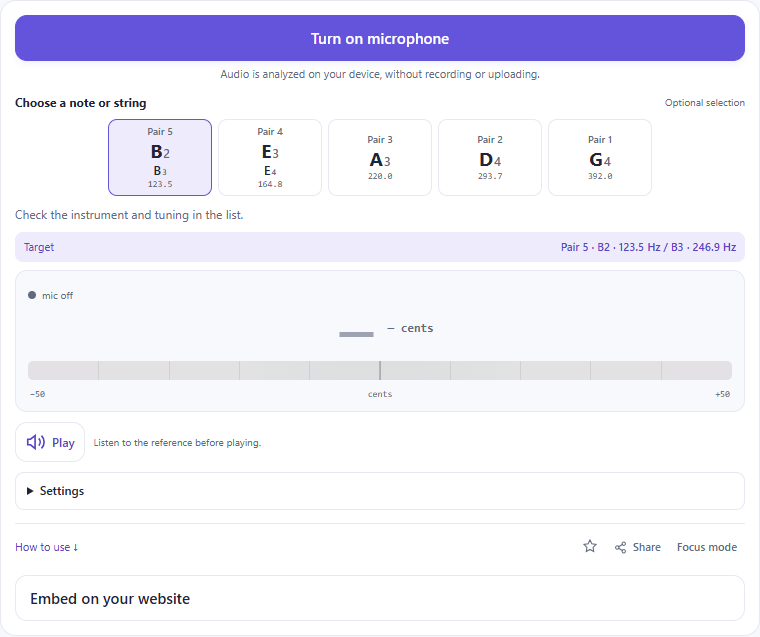
Open the Lalatone Puerto Rican cuatro tuner. The Tuning menu has one option for this instrument, Standard (B E A D G). Tap Turn on microphone and allow access. Tune in a quiet room. A guitar or a radio playing nearby can confuse the reading.
The buttons above the reading show the five pairs. The highest number is the lowest course, so Pair 5 is B and Pair 1 is G. On the two octave pairs, the button shows both notes. Tap a pair to hear its reference and lock the tuner to that course. For B and E you hear the low note first, then the high one. Let the sound finish before you pluck, because the tuner ignores the microphone while its own reference plays.
- Trace the string to its peg. Ten pegs sit close together. Follow the string up to the headstock before you turn anything.
- Mute the partner. Rest a fingertip lightly on the other string of the pair. Pluck one open string and let it ring.
- Start with A. Tune both strings of the 3rd course to A3, one at a time. It is a clear note for a phone and a good anchor for the rest.
- Tune D and G. Bring both strings of the 2nd course to D4 and both strings of the 1st course to G4.
- Tune the E pair. The thicker string goes to E3 and the thin partner to E4. The tuner labels octave readings as low string or high string (octave), so check that the label matches the string you plucked.
- Tune the B pair. The thicker string goes to B2 and the thin partner to B3.
- Go around again. A pair gets a ✓ once its notes hold in tune, but the tuner only knows the note, not which physical string you plucked. Recheck all ten strings, then play a chord you know.
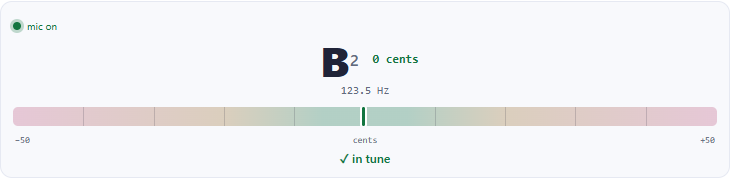
Follow the arrow on screen. ↑ flat: tighten means the string is below the target. ↓ sharp: loosen means it is above. Negative cents are flat and positive cents are sharp. Turn the peg a little, pluck again, and repeat. If you pass the note, go slightly below it and come back up.
How to check your cuatro by ear
Octave pairs: the 12th fret harmonic
For the B and E pairs, touch the thicker string lightly right above the 12th fret, without pressing. Pluck and lift the finger. The bell-like harmonic is one octave above the open string, so it should match the thin partner played open. Comparing two sounds at the same pitch is easier than judging an octave.
Unison pairs: listen for beats
For A, D and G, pluck both strings together. A slow, regular pulse means they are slightly apart. These pulses are called beats. Leave one string where the tuner put it and move the other very gently. The pulse slows down as you get closer and stops when the pair matches.
Fret checks between courses
Every course is a fourth above the one below it, so the 5th fret gives the next open course. Thick B at the 5th fret equals the open thick E. Thick E at the 5th fret equals open A. A at the 5th fret equals open D, and D at the 5th fret equals open G. Press with your normal playing pressure.
The thin partners have their own shortcut. At the 3rd fret, thin B3 gives D4, the note of the 2nd course. Thin E4 at the 3rd fret gives G4, the note of the 1st course. If one of these checks fails, the thin string is the one to look at.
With a guitar nearby
A guitar in standard tuning helps too. Its open B string is B3 and its open high E string is E4, the same pitches as your two thin octave partners. Its open G string is G3, one octave below your 1st course.
Common problems and how to fix them
The thin octave strings break
On the cuatro, the thin partners of the B and E courses work hard. In D’Addario’s tension chart for the EJ96 set, B3 and E4 carry the highest tension of the ten strings, about 26 and 23 pounds. The other strings are listed between about 18 and 22 pounds. A small extra turn on these two strings goes a long way. Never tighten a thin partner toward a higher octave because the tuner showed the wrong letter. Mute its partner, read it again and compare with the table first.
The tuner shows the right letter in the wrong octave
When both strings of the B pair ring, the microphone may follow the brighter B3 instead of B2. Mute the partner, tap Pair 5 to lock the course and pluck again. If the reading says high string while you plucked the thick string, the thick string may be close to an octave off, or the phone heard the wrong string. Do not move a string a whole octave on the basis of one reading. Use the 12th fret harmonic to decide.
A pair still beats after tuning
Each string can read in tune on its own while the pair still beats a little. For the final step, use your ears and adjust the second string against the first. Make sure both strings sit in their slots at the nut and the bridge. Old strings lose clarity and drift. If one pair never sounds clean, change it.
New strings will not stay in tune
New steel strings stretch for a while. Tune them up slowly, play for a few minutes and tune again. Across the whole EJ96 chart, the ten strings add up to a little over 200 pounds of pull. Change one or two strings at a time, or bring them all up in stages, so the neck is not loaded unevenly.
Open strings are right, but chords sound off
Press more gently first, since heavy pressure pulls notes sharp. If the open strings are correct but the same frets always sound out, the instrument may need a setup by a luthier. If your group uses a reference other than 440 Hz, set Reference A in the tuner settings so everyone tunes to the same pitch.
Puerto Rican cuatro or Venezuelan cuatro?
They share a name, but they are different instruments. The Venezuelan cuatro has four single nylon strings. D’Addario lists its EJ98 Venezuelan cuatro set as tuned A, D, F#, B, with a B3 that is lower than the D4 next to it. The Puerto Rican cuatro has ten steel strings in five pairs, tuned B, E, A, D, G.
So do not borrow tunings or string sets between them. The Puerto Rican cuatro tuner has only the ten-string tuning. For a Venezuelan cuatro, use the chromatic tuner and tune each string to the note from its string maker’s chart.
Quick answers
What are the Puerto Rican cuatro tuning notes?
From the lowest course to the highest: B2 and B3, E3 and E4, then A3, D4 and G4 with both strings on the same note.
Which strings are tuned in octaves?
Only the two bass courses, B and E. The A, D and G courses are unisons.
Why is it called cuatro if it has ten strings?
“Cuatro” means four. The name comes from older four-string forms of the instrument. The modern Puerto Rican cuatro kept the name after it grew to five pairs of strings.
Do I need an app to tune it?
No. The tuner runs in the browser on Android and iPhone. Add it to your home screen and it opens like an app.