Eleven strings, six courses
A standard oud has eleven strings but only six notes. Five of its courses are pairs of strings tuned to the same note, in the same octave (a unison). The lowest course is a single bass string. MaqamWorld describes this as the usual layout, and adds that some ouds have one extra pair, which makes thirteen strings in seven courses.
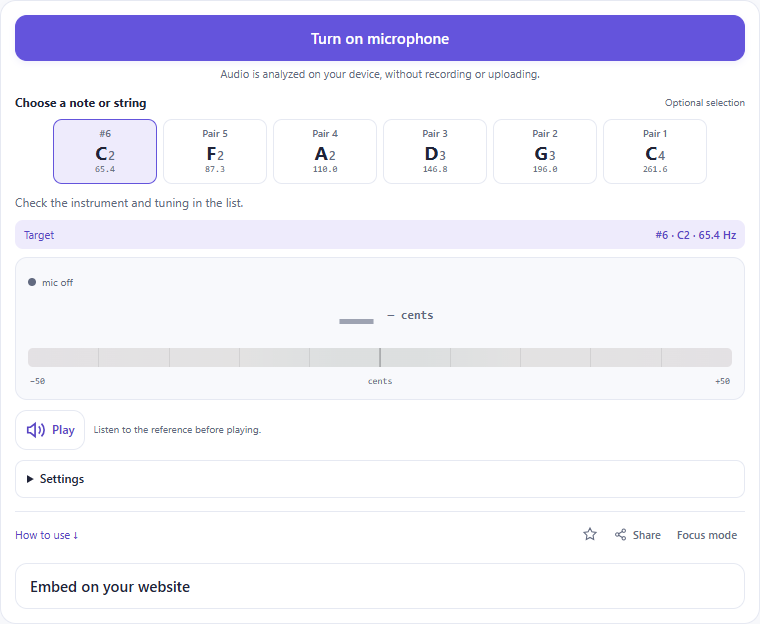
Oud players count the courses from the treble: the 1st course is the highest, nearest the floor when you play, and the 6th course is the single bass, nearest your face. The online oud tuner uses the same numbering. Its buttons read Pair 1 to Pair 5 for the doubled courses and #6 for the single bass.
Because two strings share one note, think of tuning an oud as six targets, eleven adjustments. Every string has its own peg, so each one must be checked on its own, and then each pair must be checked together.
Arabic oud tuning: C F A D G C
The most common Arabic tuning, from the bass course to the treble, is C–F–A–D–G–C. In solfège that is Do–Fa–La–Re–Sol–Do. This is the tuning of the tuner's preset Arabic (C F A D G C). The table uses scientific pitch notation, where C4 is middle C, and A4 = 440 Hz.
| Course | Tuner button | Strings | Note | Frequency |
|---|---|---|---|---|
| 1st | Pair 1 | 2, unison | C4 · Do | 261.63 Hz |
| 2nd | Pair 2 | 2, unison | G3 · Sol | 196.00 Hz |
| 3rd | Pair 3 | 2, unison | D3 · Re | 146.83 Hz |
| 4th | Pair 4 | 2, unison | A2 · La | 110.00 Hz |
| 5th | Pair 5 | 2, unison | F2 · Fa | 87.31 Hz |
| 6th | #6 | 1, single bass | C2 · Do | 65.41 Hz |
As MaqamWorld points out, almost every step between neighbouring courses is a perfect fourth: C–F, A–D, D–G and G–C. The one exception is F to A, a major third. Remembering this pattern helps you notice a course that is badly out before you even look at the tuner.
Notice the octaves. The highest course, C4, is middle C, and the bass C2 is two octaves below it. The oud is a low instrument: the oud seller Arab Instruments notes that it sounds an octave lower than many Western instruments, and oud music is often written an octave above the sound, as for the guitar. Tune to the real pitch shown in the table, not to the octave where the notes appear on the staff.
Other oud tunings you will meet
Oud tuning is not one fixed standard. It changes with the school, the player and the strings. Before you change your tuning, make sure your strings were made for it.
Changes on the two bass courses
The upper four courses, A–D–G–C, are the most stable part of Arabic tuning. The two lowest courses vary more. Arab Instruments, for example, gives D2–G2–A2–D3–G3–C4: the 6th course on D instead of C and the 5th on G instead of F, and says F2 is also used on the 5th course. Some players of the Iraqi school use quite different arrangements; the same page lists one credited to Munir Bashir.
Turkish tuning
Turkish ouds are usually tuned higher. In the common Turkish tuning listed by Arab Instruments, C2–F2–B2–E3–A3–D4, the upper four courses are one whole tone above the Arabic ones (B–E–A–D instead of A–D–G–C). String makers sell separate sets for it: Aquila's Turkish oud set, for instance, is labelled for E–A–B–E–A–D from the bass, another arrangement of the bass courses.
Two practical points follow. First, do not just pull an oud with an Arabic string set up a whole tone: the tension rises, and the gauges were not chosen for it. Second, Turkish and Arabic teachers may name pitch levels differently, so compare the real pitch on a tuner rather than the note names alone.
How to tune these with Lalatone
The oud tuner has one preset, Arabic C F A D G C. For any other tuning, open the chromatic tuner, which shows whatever note you play. Write down the notes and octaves of your tuning first, then tune course by course in the same way. For the courses that match the Arabic preset, you can still use the oud tuner's buttons.
Tune an oud step by step
Sit in a quiet place and hold the oud in playing position. Use your risha (plectrum) gently, and let each string ring.
- Set the reference. Keep A4 at 440 Hz unless your ensemble uses another pitch, such as 442 Hz. Everyone playing together should use the same reference.
- Turn on the microphone and start with the bass, #6. Tap the button to hear C2, then let the reference sound stop.
- Pluck the open string and read the note, the octave and the cents. If it is flat, tighten a little; if it is sharp, loosen. Come up to the note from below.
- Tune each pair one string at a time. Rest a fingertip on one string of the pair so it cannot ring, and tune the other. Then swap.
- Play the pair together and listen. If you hear a slow beating, move one string very slightly until it disappears.
- Go round a second time. Every turn of a peg changes the tension on the neck a little, so the first courses may have moved.
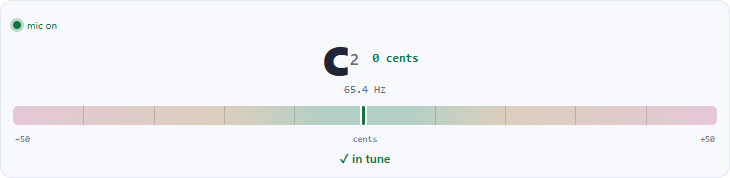
The bass C2 is the hardest course for any tuner. Its sound is low and full of overtones. Pluck it a little more firmly than the trebles, wait a moment after the attack, and read the stable part of the sound. If the reading jumps, mute every other string and try again.
Check the tuning by ear
A tuner gets you close; your ear finishes the job.
- Unison pairs. Play both strings of each pair together. In tune, they sound like one strong note. A slow “wah-wah” means they are slightly apart; a fast, rough beating means they are further apart.
- Fourths. Play neighbouring open courses together: C–F, A–D, D–G and G–C should all sound like the same, stable interval. F–A, the major third, sounds sweeter and narrower.
- Octaves. The 1st course, C4, is two octaves above the bass C2. Played together, they should blend into one deep C.
The oud has no frets, so the tuner only sets the open strings. The intervals you play on the fingerboard, including the neutral intervals and quarter tones of maqam music, depend on where your fingers fall. Learn them by ear, with a teacher or recordings, not from the open-string targets.
Common tuning problems
The pegs slip or stick
Most ouds use wooden friction pegs, which hold by pressure, not by gears. Push the peg gently into the pegbox as you turn, and make small movements. If a peg keeps slipping back, or sticks and then jumps, ask a luthier to check its fit rather than forcing it.
New strings go flat again and again
Oud trebles are nylon or similar synthetic material, and the basses are wound. New strings stretch for several days. Tune them, play, and tune again; this is normal and settles with time.
The oud goes out of tune between sessions
The oud is a light wooden instrument, and its body and pegs react to heat, cold and humidity. Keep it in its case, away from heaters and sunny windows, and let it adjust to the room for a few minutes before tuning.
Quick answers
How many strings does an oud have?
Usually eleven: five unison pairs and a single bass. Some ouds have thirteen strings in seven courses. Count the courses, not the strings, to know how many notes you need.
My oud has only five courses. Can I still use the preset?
Yes, if those courses use notes from the Arabic tuning. Find out from your teacher or maker which courses you have, then use the matching buttons and skip the missing one.
Why does my oud sound right alone but wrong with a keyboard?
Your oud may be in tune with itself but at a different reference pitch. If every course is the same small amount sharp or flat, retune all of them to A4 = 440 Hz, or to the reference the other musicians use. With friction pegs and nylon strings, recheck just before you start playing together, not only at home.
Should I use Arabic or Turkish tuning?
Use the tuning your teacher, music and strings are made for. For Arabic tuning, the oud tuner has the six targets ready; for the others, use the chromatic tuner with your own list of notes.